
Peloton Bike vs Echelon: Which Smart Bike Is Right for You?
If you’re looking for a smart exercise bike to bring the energy of studio cycling into your home, you’ve likely heard of Peloton and Echelon. Both brands offer sleek bikes, interactive classes, and a promise to make working out more engaging. But which one actually fits your goals, budget, and lifestyle?
Choosing the right bike isn’t just about the hardware. It’s about the experience: the instructors, the software, the way the bike feels, and even how much space it takes in your room. Some differences are obvious, like price. Others are easy to miss, such as the way each brand builds its community or updates its app. Many new buyers focus only on features and miss the day-to-day details that make a bike truly enjoyable—or frustrating.
This guide breaks down everything you need to know about Peloton Bike vs Echelon. You’ll see how they compare in features, pricing, classes, build quality, and more. Plus, you’ll find practical insights that most reviews skip, so you can make the smartest choice for your home gym.
Brand Background: Peloton And Echelon At A Glance
Peloton launched in 2012 and quickly changed the home fitness market. Its combination of a high-quality stationary bike and live-streamed classes created a sense of community and competition. Peloton is now a global fitness brand with millions of members, a variety of equipment, and a reputation for top-tier instructors.
Echelon entered the scene later, aiming to provide a more affordable alternative to Peloton. It focuses on value and flexibility, offering several bike models and a wide range of classes. Echelon’s ecosystem includes not just bikes but also treadmills, rowers, and even reflect mirrors, all connected through its Echelon Fit app.
Both brands have built loyal followings, but their core philosophies differ: Peloton puts emphasis on premium experience and brand identity, while Echelon highlights accessibility and versatility.
Design And Build Quality
How a bike looks and feels matters—especially if you’ll be using it several times a week. The Peloton Bike and Echelon bikes (mainly the EX series) have important differences in this area.
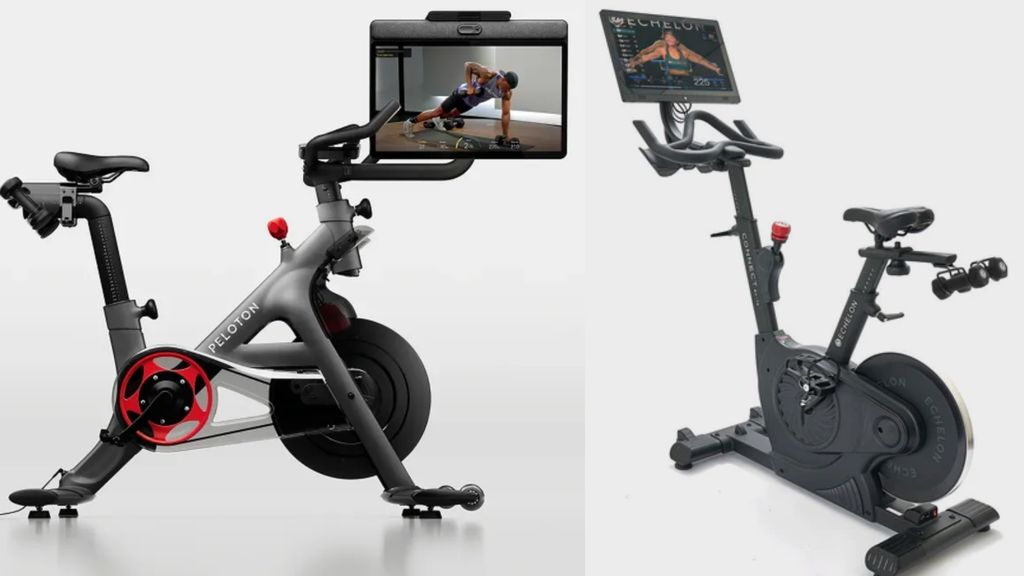
Peloton Bike
- Frame: Made from welded steel, giving a solid, premium feel. The matte black finish hides fingerprints and looks modern.
- Dimensions: About 59” L x 23” W x 53” H; fits in most home spaces.
- Weight: 135 lbs (bike only), which helps stability during intense rides.
- Flywheel: 38 lbs, ensuring smooth and consistent resistance.
- Pedals: Look Delta-compatible (clip-in cycling shoes required).
- Screen: 21.5” HD touchscreen (rotates on Bike+ model only).
- Adjustments: Handlebars and seat adjust vertically and horizontally.
Echelon Ex-5 (most Popular Model)
- Frame: Sturdy steel with plastic covers. Slightly lighter build.
- Dimensions: 54” L x 20” W x 50” H; similar footprint, a bit shorter.
- Weight: 106 lbs, easier to move but less hefty.
- Flywheel: 28 lbs, lighter but still smooth for most riders.
- Pedals: SPD-compatible on one side, toe cages on the other (more flexible).
- Screen: No built-in screen (on EX-5); you use your own device. Higher models (EX-5s, EX-7s) have built-in touchscreens (10”–24”).
- Adjustments: Multi-position handlebars; seat and handlebars move up/down and fore/aft.
Build Quality Insights
Peloton’s heavier frame and flywheel offer a sturdier ride, especially for heavier users or those who stand up often during rides. Its touchscreen is crisp and reliable. Echelon’s flexibility (using your own device or choosing a built-in screen) is a plus for some, but the frame can feel less “planted” during sprints.
Non-obvious insight: Echelon’s lighter weight means it’s easier to move, but it may rock slightly during high-intensity out-of-saddle efforts. Peloton’s heavier base is better for stability, but less portable if you need to move it often.
Hardware And Technology
The interactive features make these bikes more than just exercise machines. Let’s look at the technology that powers your rides.
Peloton Bike
- Touchscreen: 21.5” HD (rotates on Bike+), 1080p resolution, front-facing speakers, camera for video chats, and built-in microphone.
- Resistance: Digital knob, 100 levels (magnetic).
- Bluetooth: Connects to headphones and heart rate monitors.
- Wi-Fi/Ethernet: Fast connection for streaming.
- Other Features: Auto-follow resistance (Bike+ only), Apple GymKit integration, USB-C charging.
Echelon Ex-5/ex-5s
- Screen: BYOD (Bring Your Own Device) on EX-5, 10” or 22” HD touchscreen on EX-5s/EX-7s.
- Resistance: 32 magnetic levels, manual knob (no auto-resistance).
- Bluetooth: Headphones and heart rate monitor support.
- Wi-Fi: Needed for streaming classes.
- Other Features: Device holder (rotates 180° for off-bike classes), USB charging.
Comparison Table: Core Specs
| Feature | Peloton Bike | Echelon EX-5 | Echelon EX-5s |
|---|---|---|---|
| Screen | 21.5″ HD Touchscreen | None (BYOD) | 10″ or 22″ Touchscreen |
| Resistance Levels | 100 (Digital) | 32 (Manual) | 32 (Manual) |
| Pedals | Look Delta (clip-in) | SPD + Toe Cages | SPD + Toe Cages |
| Flywheel | 38 lbs | 28 lbs | 28 lbs |
| Weight Capacity | 297 lbs | 300 lbs | 300 lbs |
| Auto Resistance | Yes (Bike+ only) | No | No |
Hidden Details
While Peloton’s digital resistance is precise and easy to track, Echelon’s manual knob can be less accurate. This matters if you follow instructors who call out specific resistance numbers. Echelon’s device holder fits most tablets/phones, but smaller devices may not feel as secure during sprints.
Pricing And Value
Cost is one of the biggest factors for most buyers. The price difference between Peloton and Echelon can be significant—especially when you factor in subscriptions and accessories.
Peloton Bike Pricing
- Peloton Bike: $1,445 (base model, as of 2024)
- Peloton Bike+: $2,495 (upgraded screen, auto-resistance, better speakers)
- Accessories: Shoes ($125), weights, mat, heart rate monitor—often bundled, but sometimes extra.
- Membership: $44/month for unlimited classes (one household, multiple users).
Echelon Ex-5/ex-5s Pricing
- Echelon EX-5: $799 (no screen)
- Echelon EX-5s: $1,299 (10” screen), $1,499 (22” screen)
- Accessories: Some bundles include shoes or weights; many need to be bought separately.
- Membership: $39.99/month for unlimited classes (one household).
Cost Breakdown Example
If you buy a Peloton Bike with shoes and a year’s membership, the first-year cost is around $2,073. Echelon EX-5 with shoes and a year’s membership costs about $1,278. That’s a substantial difference.
Pro tip: Echelon often runs deals, like free accessories or discounted memberships for the first year. Peloton’s prices are more stable, but they occasionally offer free delivery or bundles.
Data Table: 1-year Ownership Cost (typical Setup)
| Model | Bike Price | Accessories | 1-Year Membership | Total (Year 1) |
|---|---|---|---|---|
| Peloton Bike | $1,445 | $129 | $528 | $2,102 |
| Echelon EX-5 | $799 | $99 | $480 | $1,378 |
| Echelon EX-5s (22”) | $1,499 | $99 | $480 | $2,078 |
Non-obvious insight: Accessories add up fast with both brands. Don’t forget the cost of compatible cycling shoes. Peloton requires specific Look Delta cleats, which are harder to find locally. Echelon’s SPD and toe cage pedals are easier for beginners or households sharing the bike.

Class Experience And Content
For many users, the class experience makes or breaks the smart bike. Both brands offer hundreds to thousands of live and on-demand rides, but the style and structure differ.
Peloton Classes
- Library: 10,000+ cycling classes, with new live rides daily.
- Types: HIIT, Power Zone, Climb, Scenic, Beginner, and themed rides (music, holidays, etc. ).
- Instructors: Famous for their charisma and motivation; some have cult followings.
- Music: Mainstream hits, curated playlists, some artist series (e.g., Beyoncé, The Beatles).
- Metrics: Tracks cadence, resistance, output, heart rate. Leaderboard shows your place in real time.
- Off-bike classes: Yoga, strength, stretching, running, meditation (included in membership).
Echelon Classes
- Library: 2,000+ cycling classes, frequent new live rides.
- Types: Endurance, Climb, HIIT, Scenic, Beginner, and special theme rides.
- Instructors: Friendly, diverse backgrounds, less “star” power but approachable.
- Music: Mix of popular and lesser-known tracks, some themed rides.
- Metrics: Cadence, resistance, output, heart rate; leaderboard is less competitive.
- Off-bike classes: Yoga, Pilates, boxing, strength, and more (all included).
Key Differences
Peloton’s class production quality is top-notch, with multiple camera angles and high energy. Its leaderboard is competitive and motivates many riders—but can feel intimidating to some. Echelon’s classes are more relaxed and often feel like a local gym: less showy, more approachable. The Echelon leaderboard is less prominent, which some users prefer.
Hidden detail: Peloton’s instructors often mention specific resistance and cadence targets. This is easy to follow on Peloton, but tricky if you use the Peloton app with a non-Peloton bike. Echelon instructors use broader ranges, which can be less precise but more forgiving for different bike models.
App, Software, And User Interface
The app is your main gateway to classes, stats, and community. It’s also where small differences can create big frustrations or rewards.
Peloton App
- Interface: Polished, intuitive, fast. Works on the bike’s screen, mobile devices, and smart TVs.
- Features: Class library, scheduling, live class booking, performance tracking, social sharing.
- Community: Leaderboard with real-time stats, hashtags, video chat, high-fives.
- Updates: Regular software improvements; very stable.
- Off-bike use: Same membership unlocks classes on phone/tablet for running, yoga, etc.
Echelon Fit App
- Interface: Clean, less polished than Peloton but easy to use. Runs on Echelon screens, mobile devices, and some smart TVs.
- Features: Class library, live class booking, performance stats, challenges.
- Community: Leaderboard, badges, Facebook integration, less direct interaction.
- Updates: Frequent, but some users report occasional bugs.
- Off-bike use: Membership includes all Echelon equipment (rower, treadmill, etc.) Content.
Software Comparison Table
| Feature | Peloton App | Echelon Fit App |
|---|---|---|
| Device Compatibility | Bike, iOS, Android, Fire TV, Roku, Apple TV | Bike, iOS, Android, Fire TV, Apple TV |
| Class Scheduling | Yes | Yes |
| Social Features | Leaderboard, video chat, high-fives | Leaderboard, badges |
| Music Integration | Curated, artist series, Spotify/Apple Music links | Curated playlists, fewer integrations |
| Performance Tracking | Comprehensive, exportable | Comprehensive, not exportable |
Practical tip: Try each app before buying—both offer trial periods. Notice how metrics display on the screen and how easy it is to find and bookmark classes. Small design details can affect daily motivation.
Community And Competition
A big part of the Peloton and Echelon experience is the sense of riding “together,” even if you’re at home. This community feeling can boost motivation—or, for some, become overwhelming.
Peloton Community
Peloton’s community is large and passionate. Users join groups by hashtag (like #PelotonMoms or #Over60Riders) and interact through high-fives, video chat, or social media. There are massive online groups where people share progress, tips, and even organize in-person meetups.
The leaderboard is highly visible. For competitive users, this is a big draw: you can see how you stack up against everyone riding right now—or filter to just your friends or age group.
Echelon Community
Echelon’s community is more laid-back, but still supportive. There are Facebook groups, brand-run challenges, and occasional “shout-outs” in live classes. The leaderboard is present but less intense, which suits riders who want encouragement without pressure.
Hidden detail: Peloton’s community is so large that it’s easy to find a niche group or support for your specific goals. Echelon’s groups are smaller but sometimes more personal. If you value being part of a giant fitness movement, Peloton stands out. If you prefer a quieter, more low-pressure group, Echelon may feel more comfortable.
Bike Setup, Delivery, And Maintenance
How easy is it to get started? What happens if something breaks? These practical issues can make a difference, especially for first-time buyers.
Peloton Setup And Delivery
- Delivery: White-glove service in most locations. Trained staff assemble the bike, test it, and walk you through basic functions.
- Setup Time: 30–60 minutes.
- Space Needed: Minimum 2’ x 4’ floor space; ceiling height of at least 8’ recommended.
- Maintenance: Peloton offers a 12-month warranty (extended available), with good customer service. Annual maintenance is simple (wipe down, check bolts).
Echelon Setup And Delivery
- Delivery: Free delivery (curbside); assembly is DIY, though instructions are clear.
- Setup Time: 30–90 minutes (faster with two people).
- Space Needed: Slightly smaller footprint; 2’ x 4’ area is ideal.
- Maintenance: 12-month warranty, with options to extend. Customer service is responsive, though some users report slower parts shipping.
Pro tip: If you’re not comfortable with tools, Peloton’s included assembly is a plus. Echelon’s DIY setup is straightforward, but allow extra time if you’re new to assembling fitness equipment.
Accessories And Customization
Both brands offer add-ons, but what you really need depends on your space and style.
Peloton Accessories
- Shoes: Required (Look Delta), not included.
- Weights: Optional (1–3 lbs), fit behind the seat.
- Heart Rate Monitor: Optional, connects via Bluetooth.
- Mat: Protects floors.
- Headphones: Any Bluetooth model works.
- Custom Gear: Peloton-branded water bottles, apparel, and more.
Echelon Accessories
- Shoes: Optional (SPD or regular sneakers with toe cages).
- Weights: Optional, some models have weight holders.
- Heart Rate Monitor: Optional, Bluetooth compatible.
- Mat: Sold separately.
- Headphones: Bluetooth compatible.
- Custom Gear: Echelon-branded bottles, mats, and apparel.
Non-obvious insight: If you plan to share the bike with a partner or family, Echelon’s dual pedals are more flexible (sneakers or SPD cleats). Peloton’s single-type pedals require everyone to use cycling shoes with Look Delta cleats.
Who Should Choose Peloton?
Peloton is a better fit if you:
- Want a premium experience with top-quality hardware and polished software.
- Crave a competitive community and enjoy seeing your name on a big leaderboard.
- Value star instructors and high-energy classes.
- Like precise, repeatable resistance and tracking.
- Prefer white-glove delivery and easy setup.
Ideal for: Fitness enthusiasts, those who love group exercise, or anyone who enjoys being part of a large, active community.
Who Should Choose Echelon?
Echelon is a better fit if you:
- Want a lower-cost entry to smart cycling.
- Prefer flexibility (using your own device or choosing screen size).
- Like a variety of off-bike workouts and equipment options.
- Want a more relaxed community without intense competition.
- Need pedal options (SPD, toe cage) for shared use.
Ideal for: Budget-conscious buyers, beginners, families, or anyone who values practicality and customization.
Real-world User Experiences
Hearing from actual users highlights important details that specs can’t show.
Peloton User Feedback
Many Peloton users say the bike “just works. ” They love the variety of classes and how the instructors motivate them. The hardware feels solid, and the software rarely crashes. Some mention the price is high, but they feel the community and energy are worth it.
A few users are put off by the need for special shoes and the competitive leaderboard, which can be demotivating if you prefer a private workout.
Echelon User Feedback
Echelon owners often mention the value for money and the flexibility of using their own device. They like the option to ride casually or follow structured classes. The community is supportive, and the variety of workouts (yoga, strength, etc. ) Is a big plus.
Some users wish for a more polished app or more famous instructors. Others note that the lighter frame can wobble during very hard sprints.
Hidden detail: Some people buy Echelon expecting a Peloton “clone” at half the price, then feel disappointed by the less-polished app or lighter frame. It’s important to match your expectations to the brand’s strengths.
Long-term Ownership: What To Expect
Peloton Longevity
Peloton bikes are built to last. The company is well-established, and the resale market is strong. Software updates keep the experience fresh, and support is solid. Most users report years of smooth use with minimal maintenance.
Echelon Longevity
Echelon bikes generally hold up well, though some users mention minor issues (like loose bolts or screen freezing on higher models). The company has grown fast and continues to improve its ecosystem. Resale value is lower than Peloton, but the lower entry price balances this.
Practical tip: Both brands require basic cleaning and occasional tightening of bolts. Peloton’s heavier frame means less shaking over time, but both should last for years if cared for.
Which Is The Better Investment?
The answer depends on your priorities:
- Choose Peloton if you want the best total experience and don’t mind paying more.
- Choose Echelon if you want the core smart bike features at a lower price and prefer flexibility.
If you’re on the fence, try riding each at a local gym or showroom. Also, explore their apps—both offer free trials, so you can see the class style, metrics, and community feel before committing.
For deeper research, check the official websites for up-to-date specs and reviews: Peloton Official Site.
Frequently Asked Questions
Is The Peloton Bike Harder To Assemble Than The Echelon Bike?
The Peloton Bike usually comes with white-glove delivery and professional assembly, so you don’t need to build it yourself. The Echelon bike is designed for easy home assembly, but it may take 30–90 minutes depending on your comfort with tools. Both include clear instructions, but Peloton’s setup is easier for those who don’t want to assemble anything.
Can I Use Either Bike Without A Membership?
Both bikes can be used without a membership, but you’ll lose access to live and on-demand classes. On Peloton, the screen will only show a basic “Just Ride” mode with no metrics tracking. On Echelon, you can ride in manual mode, but most connected features will be locked.
For the full experience, a membership is highly recommended.
Are The Classes Similar Between Peloton And Echelon?
Both brands offer a wide range of class types, from beginner to advanced. Peloton classes tend to be more polished, with higher production values and more “star power” instructors. Echelon classes are still motivating and varied but have a more relaxed, local gym feel. Try both to see which style you prefer.
Do I Need Special Shoes For Either Bike?
For Peloton, you must use cycling shoes with Look Delta cleats (clip-in). Regular sneakers won’t work. For Echelon, the pedals offer more options: you can use SPD cleats or regular athletic shoes with the toe cages. This makes Echelon more flexible, especially if multiple people will use the bike.
Which Bike Is Quieter During Use?
Both bikes use magnetic resistance, which is very quiet compared to older friction bikes. Peloton’s heavier frame absorbs more vibration, so it may be slightly quieter, especially during intense rides. Echelon is also quiet but may make a bit more noise if the floor isn’t perfectly level or during sprints.
Peloton and Echelon both offer strong options for home cycling, but their differences matter. Consider your goals, budget, and what motivates you to move. The right choice will make your workouts not just possible, but enjoyable for the long haul.

