
Choosing a smartwatch can be tricky, especially when you want to avoid ongoing subscription costs. Many devices promise smart features but tie you into monthly fees or app subscriptions that add up over time. This can be frustrating if you just want a straightforward wearable that works without extra charges.
The challenge comes down to balancing features like health monitoring, connectivity, and ease of use without paying for services you don’t need. Some watches focus on fitness tracking, others on safety or simple notifications, and not all require a phone or a subscription to function fully.
This guide will help you understand the main things to consider when looking for a smartwatch that doesn’t come with subscription fees. It will give you a clear view of what matters most so you can pick a device that fits your lifestyle without surprises.
Well, you’re choosing between a smartwatch that runs your health data on the watch itself and one that sends it to a phone app, and the difference in subscription fees follows from that. That’s the real split here. Some of these picks lean on Galaxy AI for coaching, some on Garmin’s Body Battery, and one keeps it simple with a big screen and long battery. What separates them is what’s built in, what you must supply yourself, and how long the seller covers the hardware.
Best overall: Samsung Galaxy Watch 7 — Energy Score, heart rate tracking, sleep monitoring and sleep apnea detection all come built in, with a one-year manufacturer warranty and no subscription attached.
Best for runners: Garmin vivoactive 5 — more than 30 built-in indoor and GPS sports apps, Body Battery energy monitoring, and up to 11 days in smartwatch mode.
Best lightweight tracker: Samsung Galaxy Fit 3 — a 1.6-inch AMOLED screen, 5ATM and IP68 water resistance, 101+ workout modes and up to 14 days of battery life.
The rest of this guide walks through each pick in detail, so you can match one to how you’ll actually use it.
How We Picked
We compared the Amazon listings for this guide and kept the ones that spelled out what they actually do. A listing earned a place by stating its real numbers — battery life in days, display size, water-resistance rating, how many workout modes — and by naming what the seller covers, like a stated warranty period.
We dropped anything that leaned on vague claims with nothing behind them. If a listing couldn’t tell us what was included or how long the hardware is covered, it didn’t make the cut.
We also weighed what each watch asks of you afterward. Some need a paired phone to analyze your data. Some need a separate cuff for blood pressure. That’s useful to know before you order, not after.
1. Samsung Galaxy Watch 7 40mm Bluetooth AI Smartwatch w/Energy Score

Best for: Android users who want coaching built in
The Galaxy Watch 7 leans hard on Galaxy AI, and the listing is specific about what that means. Your Energy Score is calculated from what you did yesterday, so the watch is telling you how ready you’re before you decide how hard to train. Heart rate tracking filters out body movement for a cleaner reading, which matters most during intervals and hill work when your arm is swinging.
Sleep tracking goes further than most here — the listing says it helps detect moderate to severe sleep apnea. The insights are collected by the watch and then analyzed on your phone. So your phone is part of the routine, not optional. Wellness Tips work the same way.
This isn’t for you if you carry an iPhone. It’s built for the Galaxy ecosystem, and the AI features assume a paired Samsung or Android phone.
Pros
- Energy Score built from yesterday’s activity
- Heart rate tracking filters out body movement
- Sleep tracking with sleep apnea detection
Cons
- Insights are analyzed on your phone, not the watch
- One-year manufacturer warranty only
2. Garmin vivoactive 5

Best for: Runners who want long battery between charges
Garmin’s approach here is breadth. More than 30 built-in indoor and GPS sports apps cover walking, running, cycling, HIIT, swimming and golf. If you train across several sports rather than just running, that list does more for you than any single coaching feature.
Body Battery is the standout. It reads your sleep, naps, stress and workouts together and tells you when you’re charged up or need to rest. The listing is honest that this data is a close estimation, not a lab measurement. The AMOLED display is bright and colorful, and battery life runs up to 11 days in smartwatch mode, dropping to 5 days with the display always on.
Wheelchair mode tracks pushes instead of steps, with push and handcycle activities and preloaded workouts. That’s a genuine inclusion, not an afterthought.
Pros
- Up to 11 days in smartwatch mode
- More than 30 built-in sports apps
- Wheelchair mode tracks pushes, not steps
Cons
- Battery drops to 5 days with display always-on
- Health metrics are stated as close estimations
3. Garmin Venu 3S

Best for: Buyers who want calls from the wrist
The Venu 3S takes Garmin’s health tracking and adds wrist-based calling. You can make and take phone calls from the watch when paired with a compatible iPhone or Android phone, and use your phone’s voice assistant to reply to texts. Android users can text directly from the watch.
The health side matches the vivoactive 5 closely — Body Battery, sleep score with personalized coaching, HRV status, nap detection, fitness age, stress tracking, menstrual cycle and pregnancy tracking. Battery life runs up to 10 days in smartwatch mode. The display is bright and colorful, and the 41mm case keeps it on the smaller side.
Training features include workout benefit, which shows how each session affects your body, and recovery time guidance.
This isn’t for someone who wants the longest battery on this list — 10 days is the stated figure, and always-on display will cut into it.
Pros
- Make and take calls from your wrist
- Body Battery with nap and stress insights
- Up to 10 days in smartwatch mode
Cons
- Calling needs a paired compatible phone
- Health data stated as close estimations
4. Samsung Galaxy Watch 8 40mm Bluetooth Smartwatch

Best for: Anyone who wants sleep and running coaching
The Galaxy Watch 8 pushes coaching further than the Watch 7. Advanced Sleep Coaching is the headline, and Bedtime Guidance helps you find your optimal bedtime rather than just reporting that you slept badly. Running Coach analyzes your performance and gives real-time feedback, with specific programs built for 5Ks, marathons and more.
The design is thinner than earlier Galaxy Watch models, with a cushion shape and a Quick Button. A personal AI assistant handles tasks and to-do lists hands-free, and the improved interface surfaces sports scores, news and weather at a glance.
Blood pressure tracking is here too, but read the fine print: you calibrate the watch using a blood pressure cuff sold separately, then use readings in the Samsung Health Monitor app.
Pros
- Advanced Sleep Coaching with Bedtime Guidance
- Running Coach with real-time feedback
- Two-year warranty included
Cons
- Blood pressure needs a separate cuff
- AI assistant features need a paired phone
5. Amazfit Active Max Smart Watch
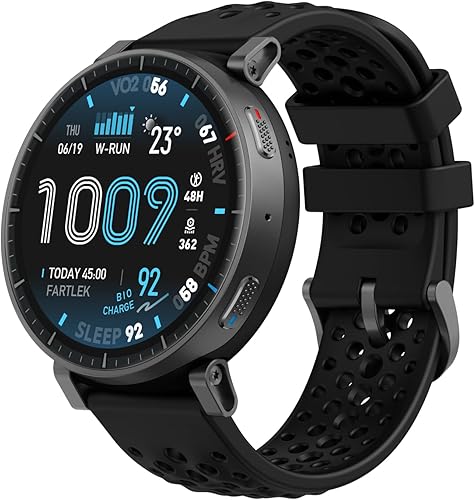
Best for: Buyers who want a big screen and long battery
The Active Max is built around size. A 1.5-inch AMOLED display rated at 3,000 nits is engineered for readability in harsh sunlight, and battery life runs up to 25 days. If charging a watch every few days annoys you, that number changes the whole experience.
Storage is 4GB, which holds music and downloaded maps with turn-by-turn directions. You can pull terrain and ski maps straight to the watch for offline navigation, with five satellite systems for positioning. Training covers 170+ workout modes plus Zepp Coach running plans from 3K through full marathon.
BioCharge energy monitoring adjusts based on your workouts and stress, telling you when to push and when to rest. Bluetooth calls work from the watch, and Zepp Flow handles hands-free message replies, though that needs an Android phone.
Pros
- Up to 25 days of battery life
- 1.5-inch AMOLED rated at 3,000 nits
- 4GB storage for music and offline maps
Cons
- Hands-free replies need an Android phone
6. Amazfit Active 3 Smart Watch

Best for: Runners who want a tough, compact watch
The Active 3 is the runner’s pick in this lineup. A stainless steel frame and sapphire glass give it a durable build, and the 1.32-inch AMOLED display stays readable in bright sun. GPS uses six satellite systems, and you can download free offline maps with turn-by-turn directions and automatic rerouting, so your phone can stay home.
The training detail goes deeper than most. Beyond Zepp Coach plans from 5K to full marathon, it tracks posture, running power, lactate threshold and ground contact time. If you care about form and efficiency rather than just distance, those are the numbers that show it.
Battery runs up to 12 days. The BioTracker sensor covers heart rate, blood oxygen, stress and sleep quality. Bluetooth calls work from the wrist, and Zepp Flow handles voice commands and speech-to-text replies on Android.
Pros
- Stainless steel frame with sapphire glass
- Tracks running power and lactate threshold
- Up to 12 days of battery life
Cons
- Speech-to-text replies need Android
- 1.32-inch display is compact
7. Samsung Galaxy Fit 3

Best for: First-time buyers who want the basics done well
The Galaxy Fit 3 keeps things simple. A 1.6-inch AMOLED display with smooth touch handles navigation, and the 208mAh battery runs up to 14 days. It is sealed against water and dust, so it’s swim-ready and dust-resistant.
Workout tracking covers 101+ modes with auto detection, which means common workouts get logged without you starting them. Health tracking includes sleep coaching, SpO2, heart rate and snore detection. There are 100+ watch faces if you like changing the look.
Two things to know before ordering. This is an international model with no warranty in the US. And it’s only compatible with Android devices — not iPhone or iOS — and Samsung Pay isn’t supported.
Pros
- Up to 14 days of battery life
- 5ATM and IP68 water resistance
- 101+ workout modes with auto detection
Cons
- No US warranty on this model
- Android only, no iPhone support
Also Worth Considering
The Amazfit Bip Max Smart Watch carries a 2.07-inch AMOLED display, GPS and iOS/Android support. If you want the largest screen in this group, that’s the one to look at — just check the full listing for battery and training details before you decide.
The CMF Watch Pro Smart Watch packs Bluetooth calling, an AI Energy Score, a 1.43-inch display, heart rate tracking, sleep monitoring, GPS, 130 sport modes and IP68 rating into a fitness tracker for Android and iOS. It covers a lot of ground on paper, and its listing is where you’ll find the specifics.
How to Choose a Smartwatch Without Subscription Fees
Do I need a subscription to use these watches?
No. Every watch on this list runs its core features — heart rate, sleep, workouts, GPS — without a recurring fee. That’s the whole point of the category. The Galaxy Watch 7 and Watch 8 run Energy Score, sleep tracking and Wellness Tips as listed features. Garmin’s Body Battery and sleep coaching are built in. Amazfit’s Zepp Coach plans come with the watch. What you should confirm before ordering is whether the phone app you’ll pair with asks for anything extra, since that’s where subscriptions usually hide.
Which one works without my phone nearby?
It depends on what you mean by “works.” The Amazfit Active 3 and Active Max both support downloaded offline maps with turn-by-turn directions, so navigation runs on the watch alone. The Amazfit Active Max stores 4GB of music and maps on board. Garmin’s vivoactive 5 and Venu 3S track GPS activities without your phone, but calling on the Venu 3S needs a paired compatible phone. The Galaxy Watch 7 listing says its insights are collected by the watch and analyzed on your phone. If phone-free navigation matters most, look at the Amazfit pair.
What should I check before I order?
Three things. First, phone compatibility — the Samsung Galaxy Fit 3 is Android only and won’t pair with an iPhone. Second, what’s included versus what you must buy: the Galaxy Watch 8 needs a blood pressure cuff sold separately to use that feature. Third, the warranty terms. The Galaxy Watch 8 includes a two-year warranty, the Galaxy Watch 7 carries a one-year manufacturer warranty, and the Galaxy Fit 3 is an international model with no US warranty. That last point is easy to miss in a long title.
Is the simplest watch here enough for me?
For a lot of people, yes. The Samsung Galaxy Fit 3 covers the basics well — a 1.6-inch AMOLED display, 101+ workout modes with auto detection, sleep coaching, SpO2, heart rate, snore detection, and up to 14 days of battery in a body that’s sealed against water and dust. If you want step counts, sleep data, workout logging and a screen you can read outdoors, that’s the job done. What you give up is the deeper coaching: no Energy Score, no running power or lactate threshold, no offline maps. If you train seriously or race, step up. If you just want to move more and sleep better, the Fit 3 is plenty.
Frequently Asked Questions
What does the Samsung Galaxy Watch 7 need to work?
The listing is specific that your Energy Score, Wellness Tips and sleep insights are collected by the watch and then analyzed on your phone. So the watch alone won’t give you those results. Heart rate tracking, workout tracking and step counting run on the wrist, but the AI-driven coaching features route through the phone. Check your phone model against the listing before ordering.
What goes wrong first on these watches?
The listings are upfront about the battery variables. The Garmin vivoactive 5 runs up to 11 days, but drops to 5 with the display always on. The Garmin Venu 3S states up to 10 days. The Amazfit Active Max claims up to 25 days, and the Active 3 up to 12. The Samsung Galaxy Fit 3 states up to 14 days from its 208mAh battery. Heavy GPS use, always-on displays and frequent notifications all pull those numbers down.
Do any of these need a separate purchase to unlock a feature?
Yes, one does. The Samsung Galaxy Watch 8 tracks blood pressure, but you calibrate it using a blood pressure cuff sold separately, then read results in the Samsung Health Monitor app. Without that cuff, the feature stays unavailable. Nothing else on this list requires an add-on purchase to work as described. Read the full listing for each before you buy, since that’s where these details live.
Closing
The Samsung Galaxy Watch 7 is the pick for most people — Energy Score, movement-filtered heart rate tracking and sleep apnea detection all come built in, with no subscription and a one-year manufacturer warranty behind it. If you train hard and hate charging, the Garmin vivoactive 5 is the one to look at, with more than 30 sports apps and up to 11 days in smartwatch mode. Before you order, check two things on the listing: whether your phone is compatible, and what the seller covers. Then pick the watch that matches how you’ll actually use it.

