
Are Dips Good For Chest Or Triceps?
If you walk into any gym, you’ll probably see people doing dips. This exercise looks simple—just lowering and raising your body between parallel bars. But dips are a classic move that can build impressive upper body strength. Here’s where it gets tricky: some people say dips are great for your chest; others say dips mainly work your triceps. So, which is it? Are dips good for your chest, your triceps, or both? And how can you target one muscle more than the other?
This article will break it all down. You’ll learn how dips work, what muscles they target, and how you can adjust your technique to hit your chest or triceps more. We’ll also cover common mistakes, how dips compare to other exercises, and give you real-world advice for getting the most from this powerful movement.
The Anatomy Of A Dip
Understanding dips starts with knowing the main muscles they use. Dips are a compound exercise. This means they work more than one muscle at a time.
The main muscles involved are:
- Pectoralis major (chest)
- Triceps brachii (back of the upper arm)
- Anterior deltoids (front of the shoulders)
Other muscles help to stabilize you, like the rhomboids and latissimus dorsi in your back, but they are not the main focus.
When you do a dip, you lower your body by bending your elbows and shoulders. Then you push yourself back up. Both chest and triceps are active, but how much each muscle works depends on your body position.
Chest Dips Vs Triceps Dips: What’s The Difference?
Not all dips are the same. Small changes in your form can shift the focus from your triceps to your chest—or vice versa. Here’s how:
Chest-focused Dips
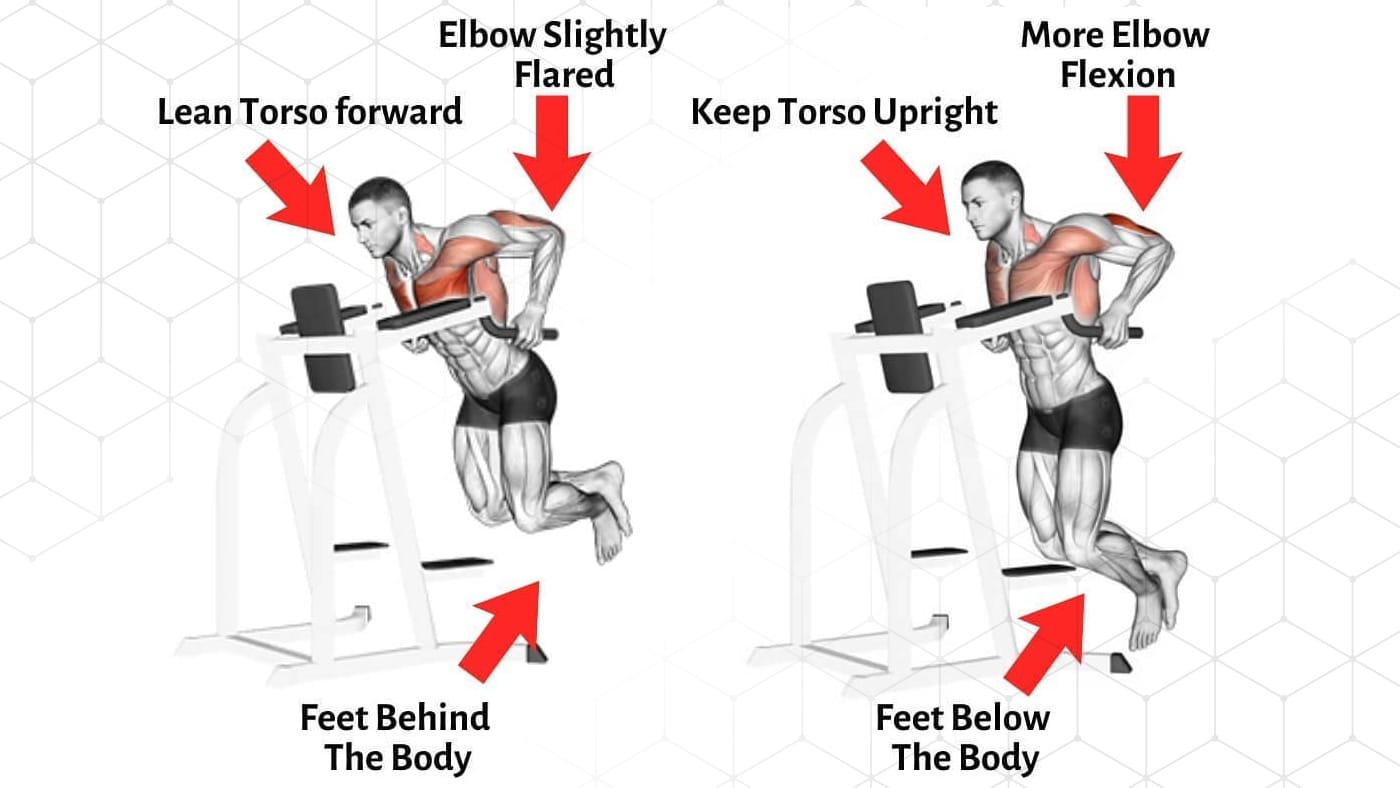
Chest dips are designed to hit the lower and outer part of your chest. Here’s how you do them:
- Lean your torso forward about 30-45 degrees.
- Flare your elbows out to the sides.
- Lower yourself as deep as your shoulders allow (without pain).
- Keep your legs slightly forward.
This position stretches and contracts your chest muscles more. You’ll feel a deeper squeeze at the bottom.
Triceps-focused Dips
Triceps dips target the back of your arms. The setup is different:
- Keep your torso upright—do not lean forward.
- Keep your elbows close to your body (pointed backward).
- Lower until your upper arms are parallel to the floor.
- Legs can hang straight down.
This puts most of the work on your triceps, not your chest.
Visual Comparison
Here’s a quick overview in a side-by-side table:
| Form | Chest Dips | Triceps Dips |
|---|---|---|
| Torso Position | Leaning forward | Upright |
| Elbow Angle | Flared out | Close to body |
| Leg Position | Forward | Vertical |
| Main Muscle | Chest (Pecs) | Triceps |
Which Muscles Do Dips Work More: Chest Or Triceps?
Dips always involve both chest and triceps, but the emphasis changes with your form. Studies using EMG (which measures muscle activation) show interesting results.
- With a forward lean, the chest works harder—especially the lower chest fibers.
- Staying upright shifts the load to the triceps.
A 2012 study from the Journal of Strength and Conditioning Research found that leaning forward increased chest activity by up to 15% compared to upright dips. Upright dips, meanwhile, produced more activation in the triceps.
It’s important to know that no dip completely isolates one muscle. Even in a chest dip, your triceps still push hard. And in a triceps dip, your chest still helps. But you can shift the focus.
Benefits Of Dips For Chest
Why do people use dips to build their chest? Here are some unique benefits:
- Lower Chest Development: Dips hit the lower part of your chest, which bench press and push-ups do not target as directly.
- Deep Stretch: The bottom position gives your chest a powerful stretch. This can help with muscle growth (hypertrophy).
- Bodyweight Strength: Dips make you lift your own body weight, which builds real-world strength.
- Joint Health: When done with good form, dips can improve shoulder stability and mobility.
An often-missed insight: dips build the “chest shelf”—the lower, outer part of your pecs. This creates a fuller, more balanced chest look, especially if you already bench press a lot.
But be careful: going too deep can stress your shoulders, especially if you lack flexibility.
Benefits Of Dips For Triceps
Dips are one of the best triceps builders for a few reasons:
- Heavy Overload: You can add weight with a belt, making dips great for advanced lifters.
- All Three Triceps Heads: Unlike pushdowns, dips work all three parts (long, lateral, and medial head).
- Functional Strength: Triceps dips build pushing strength that helps in sports and daily activities.
- Time-Efficient: You work chest, shoulders, and triceps in one move.
A key detail: dips put your triceps in a stretched position at the bottom, which some studies say is important for muscle growth.
How To Adjust Dips To Target Chest Or Triceps
Here’s how you can fine-tune your technique:
For More Chest
- Lean your torso forward (don’t round your back)
- Flare elbows out (but not too wide)
- Lower as deep as comfortable, feeling a stretch in the chest
- Pause at the bottom for a strong squeeze
For More Triceps
- Keep your torso vertical
- Tuck elbows close to your body
- Only lower until your upper arms are parallel to the floor
- Focus on straightening the arms to finish
Advanced Tip
Your grip width also changes the focus. Wider bars hit the chest more. Narrow bars hit the triceps harder.

Common Mistakes To Avoid
Many people do dips wrong and risk injury or lose results. Watch out for these mistakes:
- Going Too Deep: Dropping too low can hurt your shoulders, especially if you’re not flexible. Only go as deep as your shoulders allow.
- Shrugging Shoulders: Letting your shoulders rise up (toward your ears) makes you weak and can cause pain.
- Elbows Flaring Too Much: Letting elbows flare out too wide can strain your joints.
- Swinging or Kicking: Using momentum means you’re not working the muscles properly.
- Not Controlling the Lowering: Dropping fast can damage your joints. Lower slowly and under control.
A lot of beginners think more depth is always better. But for dips, “shoulders just below elbows” is usually enough for most people.
How Dips Compare To Other Chest And Triceps Exercises
How do dips stack up against other common moves like push-ups, bench press, or triceps extensions? Let’s compare.
| Exercise | Main Muscles | Equipment | Best For |
|---|---|---|---|
| Dips | Chest, triceps, shoulders | Parallel bars | Strength & mass, lower chest, triceps |
| Bench Press | Chest, triceps, shoulders | Barbell, bench | Upper body mass, general chest |
| Push-ups | Chest, triceps, shoulders | Bodyweight | General fitness, beginners |
| Triceps Extensions | Triceps only | Dumbbells/cables | Triceps isolation |
Dips are unique because they mix compound strength with the ability to target specific areas by changing your form.

Progression: Making Dips Easier Or Harder
Not everyone can do full dips right away. And some people outgrow bodyweight dips. Here’s how to adjust:
Easier Variations
- Assisted dips: Use a resistance band or dip machine for support.
- Bench dips: Place hands on a bench behind you, feet on the floor. This is easier but less shoulder-friendly.
Harder Variations
- Weighted dips: Add plates with a dip belt or hold a dumbbell between your feet.
- Ring dips: Use gymnastics rings. This adds instability and works more stabilizers.
Beginners often rush to add weight. But it’s smarter to master full range bodyweight dips first. You need good shoulder stability and technique before progressing.
Who Should Avoid Dips?
Dips are powerful, but they’re not for everyone. Some people should be careful:
- People with shoulder injuries: Dips can put stress on the front of your shoulder joint.
- Very tall people: Long arms make dips harder and riskier.
- Beginners with weak shoulders: Build strength with push-ups and bench press first.
If you have pain at the bottom of the dip, try a smaller range of motion or use a machine. Listen to your body.
Programming Dips For Maximum Results
How you add dips to your routine matters. Here are guidelines for different goals:
For Chest Growth
- Do 3-4 sets of 8-15 reps
- Lean forward and use slow, controlled reps
- Add dips after bench press or push-ups
For Triceps Growth
- Do 3-5 sets of 6-12 reps
- Keep torso upright, elbows tight
- Use extra weight if needed
For Strength
- Train lower reps (4-8) with added weight
- Rest longer between sets (2-3 minutes)
- Focus on full range of motion
A smart tip: Do dips early in your workout, when you’re fresh. This helps prevent sloppy form and injury.
Are Dips Safe For Your Shoulders?
This is a common concern. Dips can be tough on shoulders, especially if you go too deep or have old injuries. Here’s how to stay safe:
- Warm up shoulders with arm circles or light push-ups
- Only go as deep as you can without pain
- Keep your shoulder blades squeezed back and down
- Don’t let your elbows flare out too wide
If you feel a sharp pain, stop. Dips should feel challenging, not painful. Some people with a history of shoulder dislocation should avoid dips altogether.
Real-world Examples: How Athletes Use Dips
Many athletes and bodybuilders use dips to build upper body strength and size. For example, gymnasts do ring dips to build pushing power. Calisthenics athletes use dips as a foundation for advanced moves like muscle-ups.
Famous bodybuilders like Arnold Schwarzenegger included dips in their routines for lower chest growth. Even powerlifters use weighted dips to boost their bench press by strengthening chest and triceps together.
One non-obvious insight: Dips build grip strength and core stability, since you must control your whole body during the movement.
How To Know If You’re Doing Dips Correctly
Here are signs of good form:
- You feel your chest or triceps working, not just your shoulders
- You can control your descent and ascent (not swinging)
- No pain in your shoulder joints
- You can do 8-12 controlled reps with good technique
Record yourself or ask a coach to check your form if you’re unsure.
How Dips Help With Other Exercises
Getting strong at dips can improve your performance in other exercises:
- Bench press: Stronger triceps and chest help at the lockout
- Push-ups: Dips build endurance for high-rep push-ups
- Overhead press: Triceps strength helps finish heavy presses
Dips are a “bang for your buck” move. They work several muscles in one exercise.
Are Dips Better Than Bench Press Or Push-ups?
It depends on your goal. Bench press is better for overall chest size and maximum strength, since you can use more weight. Push-ups are safer for beginners and good for endurance.
But dips are the best for:
- Lower chest thickness
- Triceps mass
- Functional bodyweight strength
A hidden advantage: you can do dips almost anywhere if you have parallel bars or even sturdy chairs.
Sample Dip Workouts
Here are two sample routines—one for chest, one for triceps.
Chest-focused Dip Workout
- Warm-up: 2 sets of push-ups (15 reps)
- Chest dips: 4 sets of 10-12 reps (leaning forward)
- Incline push-ups: 3 sets of 12 reps
- Dumbbell flyes: 3 sets of 15 reps
Triceps-focused Dip Workout
- Warm-up: Triceps rope pushdowns (2 sets of 15)
- Triceps dips: 4 sets of 8-10 reps (upright, elbows in)
- Close-grip push-ups: 3 sets of 12 reps
- Overhead triceps extension: 3 sets of 12 reps
Try these routines once or twice per week for results.
Scientific Evidence: What Research Says About Dips
Studies have confirmed that dips are an effective compound exercise for both chest and triceps. For example, a 2017 EMG study (see PubMed) found that dips activated the chest and triceps more than push-ups.
However, the study also warned that poor form increases the risk of shoulder injury. So technique matters as much as muscle activation.
How To Add Dips To Your Routine
Here’s how to fit dips into your weekly plan:
- As a main push exercise on upper body or push days
- After bench press or overhead press for extra volume
- With other bodyweight moves (pull-ups, push-ups) for calisthenics routines
For muscle growth, aim for 50-70 total reps per week, spread over 2-3 sessions.
Equipment For Dips: What Do You Need?
You don’t need fancy equipment. Here are your options:
- Parallel bars (in most gyms or parks)
- Dip station (at home or gym)
- Sturdy chairs (for beginners, but be careful)
- Assisted dip machines (for extra support)
- Resistance bands (to make dips easier)
For weighted dips, you’ll need a dip belt or a backpack with plates.
When To Stop Doing Dips
Listen to your body. Stop dips if:
- You have sharp shoulder pain
- Your wrists or elbows hurt
- You can’t control the movement
Rest, fix your form, or switch to other exercises if you feel pain.
Frequently Asked Questions
How Many Dips Should I Do For Chest Growth?
Aim for 3-4 sets of 8-15 reps. Focus on leaning forward and using a slow, controlled movement. Quality matters more than quantity.
Can I Do Dips Every Day?
It’s better to give your muscles rest. Do dips 2-3 times per week, with at least one rest day between sessions. Daily dips can lead to overuse injuries.
Are Bench Dips Good For Chest Or Triceps?
Bench dips mostly work the triceps, but they can strain your shoulders. Regular parallel bar dips are safer and better for building both chest and triceps.
Do Dips Make Your Chest Bigger?
Yes, especially the lower and outer chest. Dips add thickness and fullness, but you should combine them with other chest exercises for best results.
What If I Can’t Do A Single Dip?
Start with assisted dips (using a band or machine), or do negative reps (lower slowly, then step back up). Push-ups and bench press also build the strength you need to progress to dips.
Dips are a classic for a reason: they are simple, effective, and versatile. Whether your goal is a bigger chest or stronger triceps, mastering dips can help you get there. Remember, form matters more than reps or weight. Listen to your body, progress at your own speed, and dips will reward you with real upper body strength.

